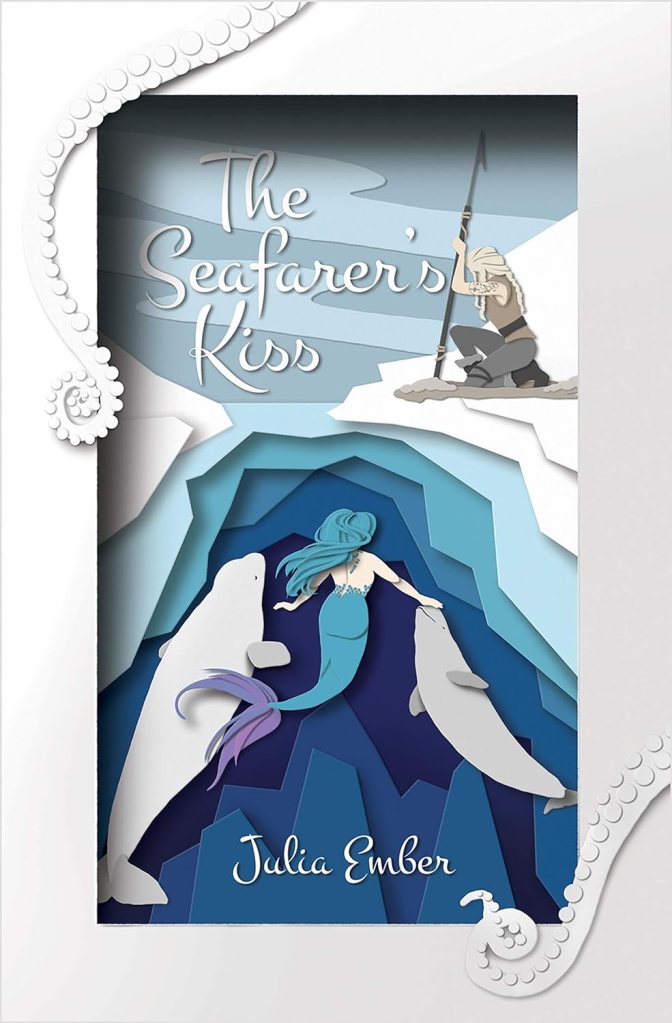
Title: The Seafarer’s Kiss
Author: Julia Ember
Publisher: Interlude Press – Duet Books
Published Date: 1st May 2017
Page Count: 224
ISBN: 978-1945053207
Price: $13.78
Reviewer: Gwendoline SK Terry (9th April 2024)
Blurb
Having long wondered what lives beyond the ice shelf, nineteen-year-old mermaid Ersel learns of the life she wants when she rescues and befriends Ragna, a shield-maiden stranded on the merfolks fortress. But when Ersels childhood friend and suitor catches them together, he gives Ersel a choice: Say goodbye to Ragna or face justice at the hands of the glaciers brutal king. Determined to forge a different fate, Ersel seeks help from the divine Loki. But such deals are never straightforward, and the outcome sees her exiled from the only home and protection shes known. To save herself from perishing in the barren, underwater wasteland and be reunited with the human shes come to love, Ersel must try to outsmart the God of Lies.
Review
I rated this book 4 stars on Goodreads, rounding up from the 3.5 that I actually feel the book is worth. Since writing this review, I’ve lowered my rating down to 3 stars. This is a good story, with bi and nonbinary representation, but it isn’t spectacular. There were plenty of twists but overall, the story is predictable, but, to be fair, that is to be expected since it’s based on the famous Little Mermaid story. Lovely, creative setting, but the characters are flat and there were a lot of interesting and promising titbits that were mentioned but left unexplored. Ersel was understandable and I sympathised with her, but she was not particularly likeable.
I was so excited when Ersel received tentacles instead of human legs. I loved the idea of the story following Ursala’s origin instead of retelling Ariel’s, but Ersel didn’t become the evil sea witch we all know and love.
For a short fairytale, it carries a heavy message: women are judged by their fertility, the higher their fertility, the higher their worth. The heroine is justifiably outraged by the system and seeks to escape it at first, before ultimately staying to dismantle it.
Ersel’s smug reaction to Vigdis having a low fertility was not unrealistic at all considering how Vigdis teased and bullied Ersel throughout her life. However, I do think Ersel should’ve been more upset by Vigdis’s death since Ersel literally caused it.
I found the scene where Ragna and Ersel punch each other in the face startling and out of place. Violence against anyone, partner or not, is wrong and it seemed strange that a story promoting fairness, equality, women’s rights, etc, would include and condone domestic violence. Punching your partner once is one punch too many.
As a fairytale, it obviously has the ideal happy ending. Short, and simple, this was a quick, and ultimately enjoyable read, but I’m in no hurry to purchase the sequel.
 gwensalir